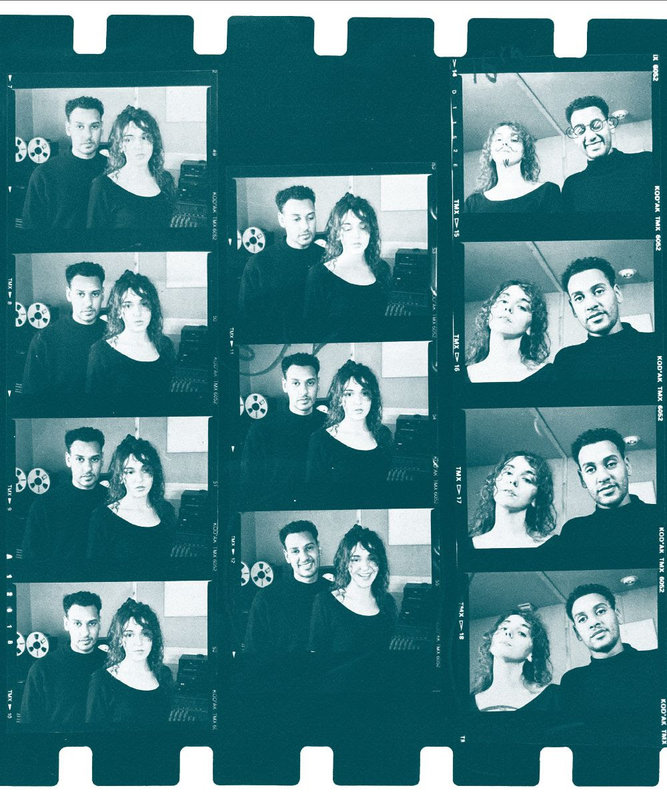
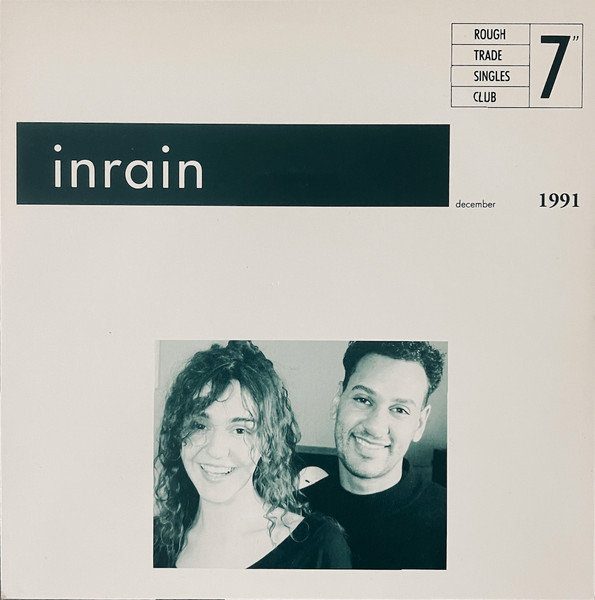
In 1991, Rudy Tambala of A.R. Kane and Alison Shaw of Cranes came together to release a collaborative 7" record through the Rough Trade Singles Club series as inrain. Across three songs, 'Grow', '...And Julie Rose,' and 'Sleep', they mapped out a sensibility that split the difference between dream-pop, shoegaze and the emerging sounds of trip-hop. Underscored by classical sensibilities, restrained art-pop melodies, and nods towards the UK's rapidly transforming '90s electronic music landscape, their "Grow" EP was a quiet gem of nocturnal music for anyone who has ever spent the after-midnight hours wondering about the world and their place in it.
Thirty-five years later, the songs on "Grow", and two other unheard inrain cuts, 'Biology' and 'Sleep (Piano Mix)', are on the verge of returning to us as a gloriously remastered 12" vinyl and digital release package titled 'Rise' on April 23 2026, via the good people at Music From Memory. In advance of the release date, I emailed Rudy and asked him to reflect on the project and the era in which it was created. His answers were honest, refreshing and funny.
Test Pressing: Could you describe what was going on in your world in the lead-up to Inrain?
Rudy Tambala: I was just emerging from a few years of intense A.R. Kane activity, and I had also ploughed Kane cash into building a studio (H.Ark!) in Stratford, E.15. I started doing some music for ads and MTV stings, then it progressed into becoming a production company, label and commercial studio. I was well busy. I produced some stuff for Rough Trade - our label at the time - I most remember Boo Radleys. Crazy, talented guys. Alex was off in the USA chasing different dreams.
How did you feel about what was going on in music at the time?
We’d had the Second Summer of Love, and the rave scene was in full throttle. I liked some of the emerging electronic music, especially the dub-influenced Jungle and Trip Hop. Acid House, not so much, as it seemed very constrained initially. Later, house music got deeper and more nuanced. Rock-wise, I think we had hit the high watermark already. I don’t think much new was happening - just rehashed rock n roll, and journeys into noise, introspective experimentation - maybe it was what is now called post-rock and shoegaze.
Do you remember when you first started hearing Allison Shaw's music with Cranes?
Geoff gave me a demo of Cranes, Sundays and various other bands. It was impossible not to compare them all to the Cocteau Twins, but I tried to listen to what was unique. Alison was certainly unique. I loved her voice and style immediately. We arranged to meet at H.Ark! - I think she came with her manager - good move, I wouldn’t want to travel on my own to the East End to meet some moody producer in an industrial unit! We chatted and hung out for a while, and just said ‘Yea, let’s do some music together’. It was easy. Right.
When you started making music as Inrain, did you envision it as music DJs might gravitate towards?
I never thought about DJs at all. At the time, I didn't like them on the whole - “FFS they just play other people’s music” was my mentality then.
Writers note: Thinking about 'Pump Up the Volume' by M|A|R|R|S while I was reading this made me chuckle.
Did you start working together straight away?
We just got straight to work. Jamming ideas together, developing them. Taking bits away. Getting back together, evolving the ideas. It went on for several months. We really enjoyed each other’s company and were never rushed. I think we had great musical chemistry, possibly the best since I’d worked with Alex. In another world we’d probably have had a fully fledged band together.
What do you think you found together that you might not have found otherwise?
Chemical reactions are unique. Add this element to that element, and you get… Well, whatever you get. Alison and Rudy, at that time and that place, reacted in a way we labelled ‘inrain’. It was what it was. Couldn’t have been different. Could never have been the same.

What sort of expectations did you have for the music at the time?
I don’t think either of us thought much about that kinda thing. We worked intimately, in our own little bubble. What unfolded was quiet and simple. It was nice.
What has it been like revisiting this work? Did you take any convincing, or were you right into it?
I have been approached several times over the years to re-release the tracks, but until now, it never felt quite right. Music From Memory is the perfect new home for inrain. The remastering blew me away - the songs now sound the way I wanted them to, but couldn’t achieve for the RT Singles Club 7” single. Tako, Jonny, Boris - they are all so warm, open and lovely to work with - they make loving fun!
How did you reconnect with Alison to record 'Biology' in 2012?
Alison lived on the south coast, and my family had a place nearby on the Isle of Wight. We decided to just meet up and see how it went. The moment I arrived at Alison's place, it was - "Hey, can I play your guitar? I have a tune, what do you think?" Same as before. Instantaneous musical chemistry. Over the next several months, we worked on a bunch of ideas and did some demo mixes. We sent them out to a few labels, but got no real interest. One of the tracks was Biology. We both thought it would be a nice addition to Rise; simple, intimate.
Decades later, what do you think are the best and worst things about releasing music and performing circa 2026?
Best: releasing is 100% self-sufficient. Worst: lack of limits can mean drifting a bit. It’s hard to get marketing cut-through - there is so much music out there. Post office runs - OMG!
Best for performing: it’s nice to have appreciative crowds that know your music and give such a positive vibe. Worst: getting home after a gig. I desperately need a tour manager!
This interview has been lightly edited for readability.
Rise by inrain is due for release through Music From Memory in vinyl and digital formats on April 23 2026 (pre-order here)